How to Play Rummy 51 (Card Game)?
There are countless great games played with a simple deck of cards: Poker, Solitaire, War... but have you discovered Rummy 51? Let me teach you how to play – you're going to love it! 😊
- To lay down your first meld on the table, your combinations must total at least 51 points.
- This initial meld must include at least one pure sequence (tierce franche) of 3+ consecutive cards in the same suit created without any Joker.
✍️ What You Need to Play Rummy 51

Rummy 51 is a multiplayer card game; it is best played with 3 or 4 players, with a minimum of 2. You will need two standard 54-card decks (including Jokers, totaling 108 cards). For larger groups, an extra deck can be added. Rummy 51 is easy to learn and fun for all ages.
Basic mental math is useful, as counting points is essential. For kids under 10, a little patience and counting on fingers makes it a wonderful learning experience! 🤓
♠️ Introduction to Rummy
Rummy 51 is an individual card game: everyone plays for themselves 😛. The main objective is to be the first to meld and lay down all cards from your hand. At the end of the round, the fewer unmelded cards left in your hand, the better 😊.
Each card carries a specific point value: Face cards (King, Queen, Jack) and the 10 are worth 10 points each. The Ace is worth 1 or 11 points depending on its placement. All numbered cards (2 through 9) are worth their face value. The Joker is a special wild card that can substitute for any card 😎 and takes on the point value of the card it represents.
Why is it called «51»? 🤔 It represents the threshold required to make your initial meld on the table… 😊
While regional variants exist, this guide presents the standard, most widely played official rules.
♦️ Round Setup and Dealing

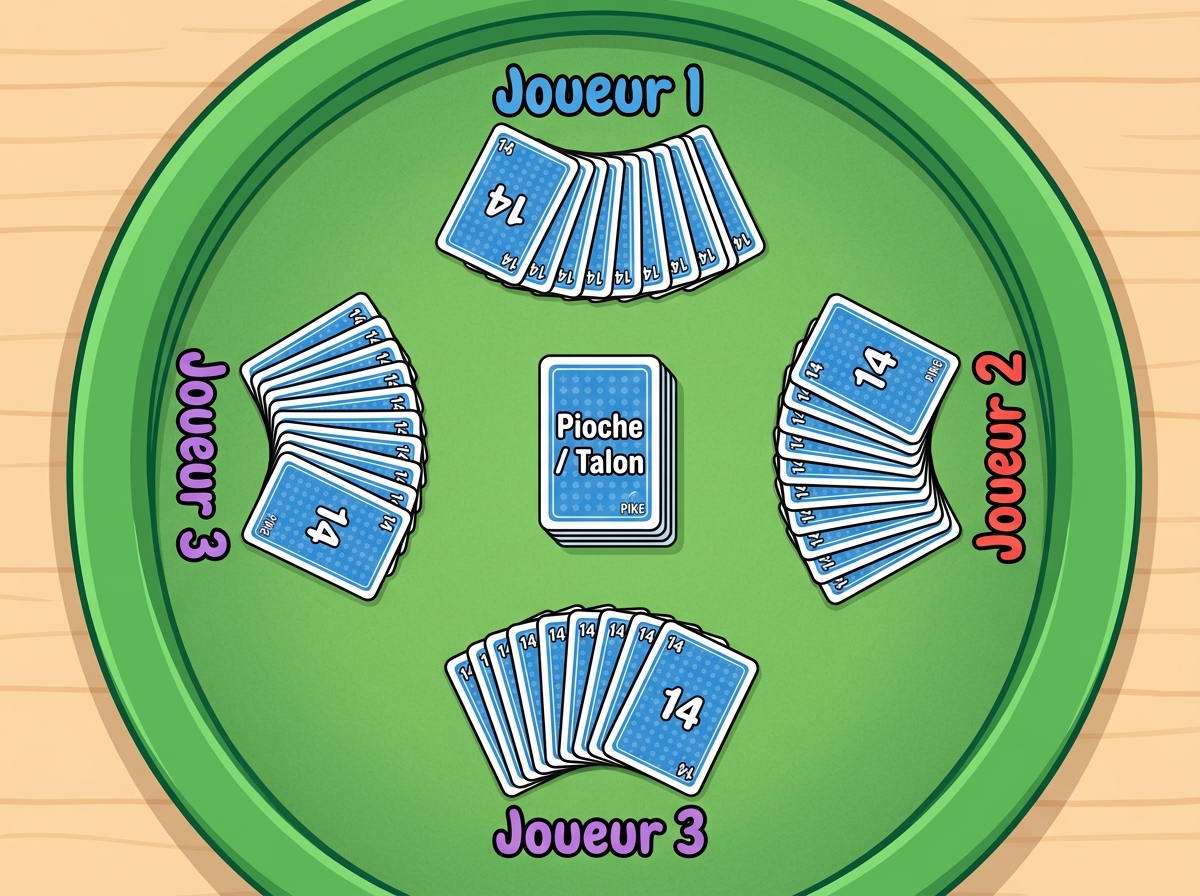
First, shuffle both 54-card decks together thoroughly. Each player draws a random card: whoever draws the highest card plays first. Play continues clockwise.
The dealer deals 14 cards face down to each player. The remaining cards form the face-down Stock Pile (draw pile) at the center of the table.
The first player draws a card from the stock, holding 15 cards in hand to start the turn.
🚩 Forming Melds to Reach 51 Points
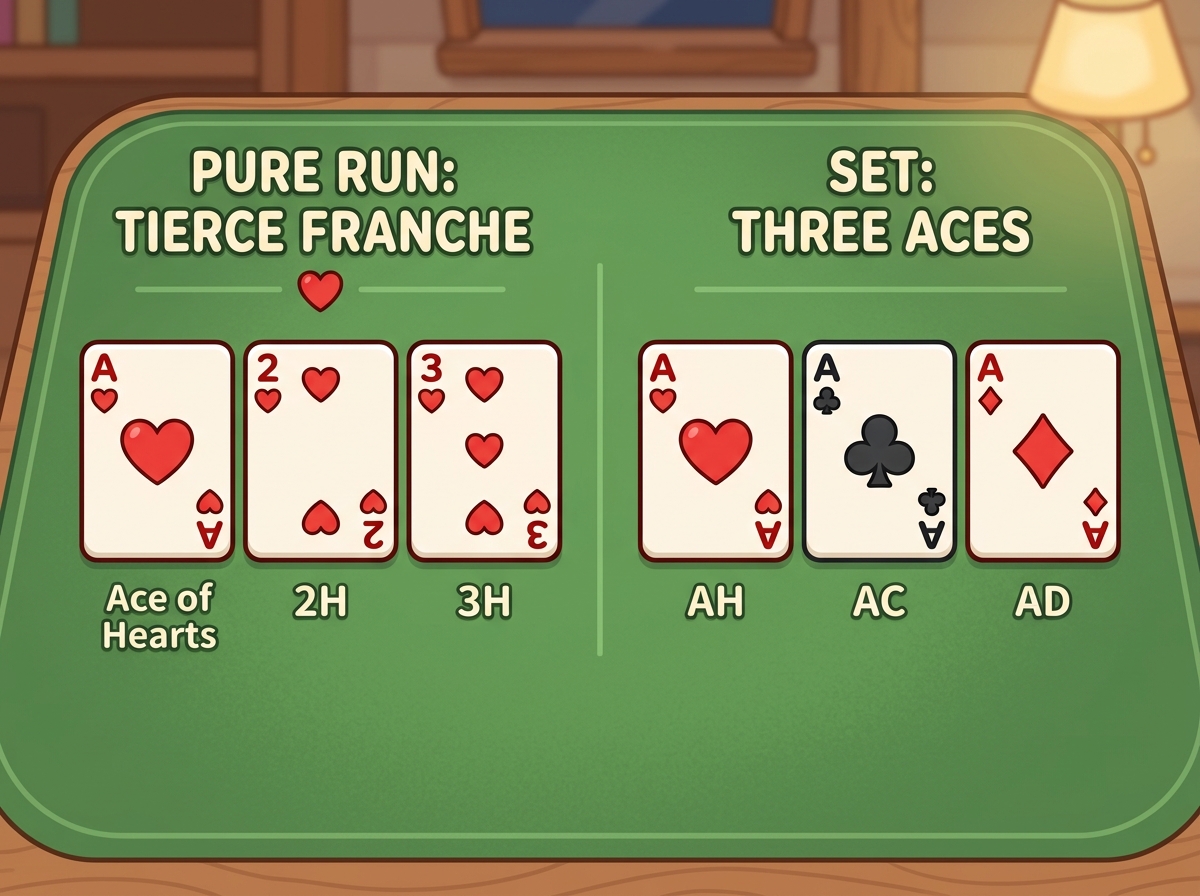
The principle is straightforward: form valid combinations of at least 3 cards (runs/sequences in the same suit, or sets/groups of the same rank in different suits).
Let's look at Player 1's starting hand of 15 cards as an example:
- 1 Joker 🃏,
- 2 Kings of Hearts ♥️,
- 3 different Aces (Hearts ♥️, Clubs ♣️, Diamonds ♦️),
- 1 second Ace of Clubs ♣️,
- 1 Two of Hearts ♥️,
- 1 Three of Hearts ♥️,
- 2 Fives (Diamonds ♦️ and Hearts ♥️),
- 1 Nine of Spades ♠️,
- 2 Tens (Spades ♠️ and Diamonds ♦️),
- 1 Eight of Clubs ♣️ (just drawn).
Here we find: Ace, Two, and Three of Hearts ♥️. This is a natural Pure Sequence without any Joker.
We also have 3 different Aces (Set of Aces). Let's count the points: 3 Aces (33 points) + Pure Sequence (1 + 2 + 3 = 6 points) = 39 points. 39 is less than 51, so Player 1 cannot open yet!
Why is the Ace worth 1 point in the low sequence? In an A-2-3 run, the Ace counts as 1; in any other position (like Q-K-A or a set of Aces), it counts as 11 points.
📣 Discarding and Passing the Turn

The player must discard one unwanted card face up next to the stock pile to end their turn and pass play to the next player.
The next player may draw from the stock pile or take the discarded card – but only if they immediately meld and lay it down on the table!
📍 Laying Down and Laying Off Cards
Once you have opened with 51 points and a pure sequence, on future turns you can lay down new melds and add cards to existing melds on the table (laying off).
At the end of every turn, you must discard one card. When you have only 1 card remaining in hand, you must declare «Card!» to warn opponents that you are about to go out.
🃏 Using the Joker in Rummy
The Joker can substitute for any card (e.g., Ace + 2 + 3 + Joker + 5 of Hearts = 15 points).
A Joker cannot be used inside the opening pure sequence. If you replace a Joker on the table with the real card from your hand, you must immediately reuse that Joker in a valid meld.
♦️ Going Out Hand Rummy (Rami Sec)!
If a player melds their entire hand in a single turn before anyone else has opened, it is called a Hand Rummy (Rami Sec). In this case, all opponents' penalty points are doubled!
♣️ End of Round & Point Scoring
When a player goes out by shedding all cards, the round ends and opponents count penalty points for remaining cards in hand:
| Card Rank | Penalty Points |
|---|---|
| Ace | 11 points (or 1 in low run) |
| King, Queen, Jack, 10 | 10 points each |
| 2 through 9 | Face value |
| Joker | 20 points |
| 14 cards unmelded (failed to open) | 100 points (200 in Hand Rummy) |
The player with the lowest total score at the end of the match is the winner! 🤑
Frequently Asked Questions
How many points do you need to open in Rummy 51?
You need a minimum of 51 points combined across your initial melds, which must include at least one pure sequence of 3+ consecutive cards in the same suit made without any Joker.
Can you use a Joker in the initial pure sequence?
No, the pure sequence required for the initial 51-point meld must be 100% natural and cannot contain any Joker.